
Identify a Cook County Property Owner
Cook County splits the answer across two records. The Board of Tax Assessors keeps the parcel card that names an Owner, while the Clerk of Superior Court records the deed showing the grantee who received the interest. Start with the free tax record. An address works well there. End with the deed, because that recorded instrument is the legal proof of transfer.
The order also helps with rural sites. A physical address may be incomplete, yet the parcel ID and legal description build stronger links between the two offices. Copy every space and letter in the displayed parcel number. Cook County publishes no key for decoding the parts of those formats, so treat the number as a single label rather than a code to break down.
- Enter the physical address in the Cook County qPublic search. Try a shorter street form if the full address does not match.
- Open the right parcel and record the Owner, Mailing Address, Physical Address, Parcel ID, Sales, and any Deed Book or Plat Reference.
- Search that owner as the newest grantee in the GSCCCA real-estate index. Match the legal description and deed reference, not the name alone.
- If the name is a company, trust, or estate, keep that legal owner name intact and use the proper entity or probate record for context.
Read Cook County Owner Fields
On the qPublic parcel card, the Owner field is distinct from where the land sits. Verified fields include Owner, Mailing Address, Physical Address, and Parcel ID. They also cover class code, taxing district, acres, assessed value, last sales, and recorded references. Assessment correspondence goes to the mailing address. That may be a post office box, an entity office, or a trustee's address. It never proves the owner lives on the parcel.
The Physical Address, also called the situs address, locates the land itself. In the Cook sample it is only a road name, not a full postal address. So the parcel ID and legal description matter most. They settle the question of who owns this property. They separate lookalike streets and people who share a name.
- Owner of record
- The name carried on the current public assessment roll.
- Grantee
- The party receiving the interest in a recorded deed.
- Situs address
- The physical location of the parcel, which differs from the owner's mailing address.
- Title
- The legal rights in land, which require more than one portal result to evaluate.
Cook County Ownership Sources
Each Cook County source answers a narrower ownership question. The assessor roll gives the fastest identity clue. The deed index shows who received an interest, and when. The map ties the parcel card to the right tract. Never substitute one for another in silence.
| Where the owner appears | What it contributes | Freshness and access |
|---|---|---|
| Cook qPublic parcel card | Owner label, mailing and physical addresses, parcel ID, sales and deed reference | Free online; office and phone fallback |
| Clerk deed index and GSCCCA | Grantor, grantee, instrument, recording date, and book/page | Index and images may require an account or payment; all deed and plat records are public onsite |
| qPublic parcel map | Selected parcel, surrounding parcel labels, roads, aerial context, and linked card | Free reference map; not a survey |
| Georgia eCorp search | Business entity name, control number, registered agent, and officers | Free context when a company owns the parcel |
The assessor sits at 209 N. Parrish Avenue in Adel, reachable at (229) 896-3665. The Clerk of Superior Court is at 212 N. Hutchinson Street, open weekdays 8 a.m. to 5 p.m., phone (229) 896-7717. Use these direct channels when a web record stalls or a fresh filing has not surfaced.
Check a Recent Cook County Sale
Cook County publishes no tax-roll refresh interval and no standard closing-to-update delay. Any claim that a parcel card updates within a set number of days is unsupported. After a recent closing, compare the qPublic Owner and Last Sales fields against the newest GSCCCA entry. Then ask the clerk whether the deed has been recorded and indexed.
One official sample parcel card showed a 2021 upload timestamp. That proves a card can display an upload date. It says nothing about the county's current schedule. Read whatever date appears on the live result. A newly recorded deed may be the fresher ownership clue.
Note: Assessor data can lag a transfer. Confirm a fresh Cook County owner against the latest indexed deed.
Trace Cook County Entity Owners
A parcel may carry the name of an LLC, corporation, trust, or estate. That stands in for a person. The result is not incomplete. The entity can be the legal owner. Search the exact displayed name first, punctuation and abbreviations included. For a Georgia business, the Secretary of State eCorp search handles lookups by business name, control number, registered agent, and officer. It also covers designated agent.
Agent or officer data may explain a distant mailing address. It does not make that person the landowner. Trusts can sit under a trustee's name or a shortened trust title. Estates may point to Probate Court and an executor's or estate deed. In every case, anchor the work with the parcel ID, deed book and page, and legal description. That keeps the search on the same Cook County tract.
Follow Cook County Sales References
According to the local clerk, qPublic files deed-book references under Sales. That is the bridge from a quick answer to recorded proof. Last Sales rows can carry a date, price, reason, and qualification. A blank price or coded sale does not undo the transfer. It may signal a non-market conveyance. It could be an estate matter, or a record that only the deed image explains.
GSCCCA supports name, grantor and grantee, book and page, date, instrument type, property, map, subdivision, lien, plat, and PT-61 searches. Some tools are premium. Cook participation should be checked for specialized modes. If an online image is blocked, the courthouse counter offers public deed and plat research. Mail or call the clerk for copy and certification steps. Cook County has no universal deed-request form.
Watch New Cook County Filings
Georgia's Filing Activity Notification System, known as FANS, watches for new Cook County filings that match the criteria a subscriber sets at signup. Cook's clerk links to the system from its real-estate page. The FANS portal is where those forward-looking alerts begin.
The service has clear boundaries. Alerts start only after a request exists and a document has been indexed and transmitted. FANS cannot answer who owned the property last year. Silence never proves that an older instrument is missing.
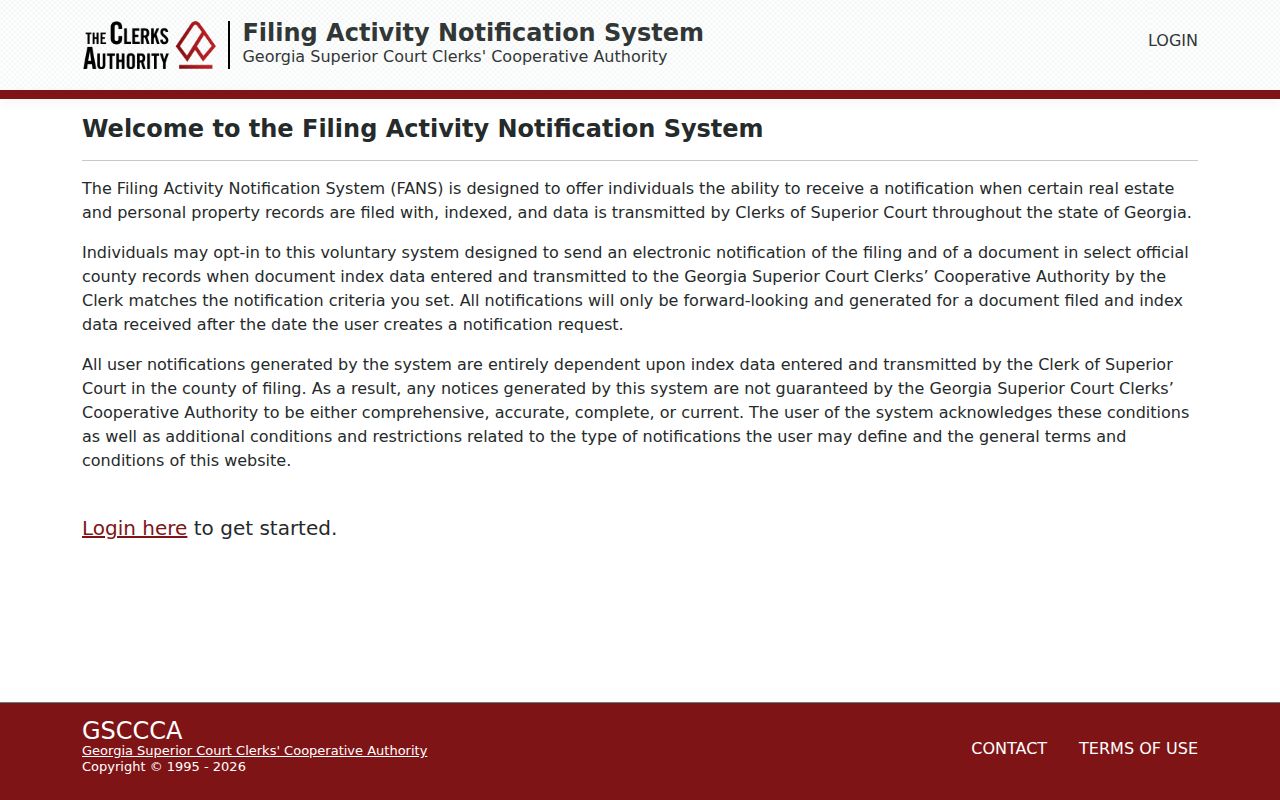
The service's own page stresses that alerts supplement a deed-index search rather than replace it. That forward-looking reach is the real value. An owner can catch a suspicious new deed or lien quickly.
Georgia also began an identity-validation process for title deeds and related property filings in 2025. A troubling alert deserves a check against the official index. Report confirmed problems to the clerk. Law enforcement should hear about it too. Treat any unsolicited deed copy or property offer letter with suspicion.
Reach Cook County Records Offline
Online tools are not the only route. The clerk also provides onsite review of deeds, liens, plats, and UCC filings. Standard office copies run $0.50 per page. A certified copy costs $2.50 for the first page plus $0.50 for each added one. Online and unusual-copy schedules differ, so confirm the transaction before ordering.
When a public record is not posted, a written Georgia Open Records Act request can help. The request can name the address, parcel ID, book and page, date range, record type, and format wanted. Agencies generally must produce the record. They can also respond with a status, timeline, cost, or exemption within three business days. The law does not force the county to create a title report. Older ownership puzzles can also lead to the Georgia Archives. A local historical society or the library may help as well.
Limits of Cook County Owner Lookup
A tax-roll name shows who Cook County assesses as owner of record. It does not reveal who occupies the land. It cannot define every future interest or resolve a life estate. It cannot prove boundary corners or guarantee clear title. The parcel map itself warns against use in legal documents. When the stakes call for more, buyers and heirs should turn to the latest deed, plats, liens, and releases. They should also review probate records and professional title work.
Public access has firm limits too. Protected voter addresses, sealed records, confidential vital records, and similar restricted data should never be pursued through workarounds. A published owner mailing address deserves use only for a legitimate property matter.
Ownership is not title proof. A Cook County owner name may be stale or held through an entity. Do not use public records to target, intimidate, stalk, or harm anyone.