
Reconstruct Cook County Former Owners
Building a backward deed chain means reading a timeline in reverse. Start with the deed that conveyed the parcel to a known owner. The grantor named in that instrument becomes your next grantee to chase. Compare each new deed against the last before adding anyone, and never assume a transfer date or a party without opening the actual document.
| Transfer date | Grantor to grantee | Deed type | Book/page |
|---|---|---|---|
| Newest recorded date | Prior owner to present grantee | As indexed | Current deed reference |
| Previous recorded date | Earlier owner to that prior owner | As indexed | Earlier acquiring deed |
| Next earlier date | Repeat with the same tract | As indexed | Earlier book and page |
A careful working table guards against one common mistake. It is easy to treat every deed filed under a name as part of the parcel's story. That is rarely true. Check the legal description and plat references at every generation of the chain. Instruments like a security deed, a release, a lien, or a correction can shape the record. They never introduce a new prior owner of the property.
Know Cook County's Online Limit
Cook County's online coverage has a firm edge. GSCCCA publishes no statement of the earliest Cook year its deed index reaches, so treat that boundary as a limit rather than something to estimate. The statewide portal does advertise a full set of search modes, including grantor, grantee, book and page, date, instrument type, property, subdivision, lien, plat, and PT-61. Some tools and record images sit behind an account or a payment wall. Every Cook deed and plat record stays open for public research at the Clerk of Superior Court, 212 N. Hutchinson Avenue in Adel. Call (229) 896-7717 before you make the trip. Walk-in hours run weekdays from 8 a.m. to 5 p.m. Staff there can help you trace previous owners through the older images the office holds.
No published cutoff. Cook County does not state the first online deed year. Continue at the clerk, in deed books, or on microfilm when the index stops.
Walk Cook County Deeds Backward
Start from today's parcel card. Its owner of record, sales history, deed reference, parcel number, and legal description form the working set. That set anchors your search. From there, pull up the GSCCCA search menu or work the index at the courthouse. A name alone proves nothing. Match the property description on the deed to the parcel. Only then does that name earn its spot in the chain of title.
- Find the present owner's acquiring deed, with that owner indexed as grantee.
- Read the grantor and full legal description from that transfer.
- Search the grantor as an earlier grantee, then verify the same tract and book/page.
- Repeat until the web index ends, then continue with the clerk's deed books and archive finding aids.
- Grantor
- The party conveying an interest.
- Grantee
- The party receiving that interest.
- Chain of title
- The linked sequence of transfers for the same land.
- Reverse index
- An index organized to help find parties in the opposite role.
- Quitclaim and warranty deeds
- Different instruments that convey interests with different promises.
Cross Cook County's 1918 Boundary
Cook County was carved out of Berrien County in 1918. So a title chain reaching back before that year may run through Berrien's deed books, land-lot records, and plats. Search by legal description, land lot, and district instead of relying on a modern Cook address alone.
The 1939 courthouse anchors much of the county's record story. No courthouse fire is documented for Cook. No source confirms that every volume survived either. Georgia Archives county cards list record dates, holdings, and disaster notes for each county. Read the card before assuming older deed records are missing.
Extend Cook County Ownership Research
Once Cook's online deeds run out, the Georgia Archives County Records Microfilm Index becomes the main finding aid. Most of its holdings cannot be searched by owner name. A card lists record titles and date ranges, and then you browse the index volume or film itself. Archives research help also points to the FamilySearch Catalog, where older deed books may be image-browse only.
The GSCCCA search landing page displays the statewide record modes used before the archive handoff.
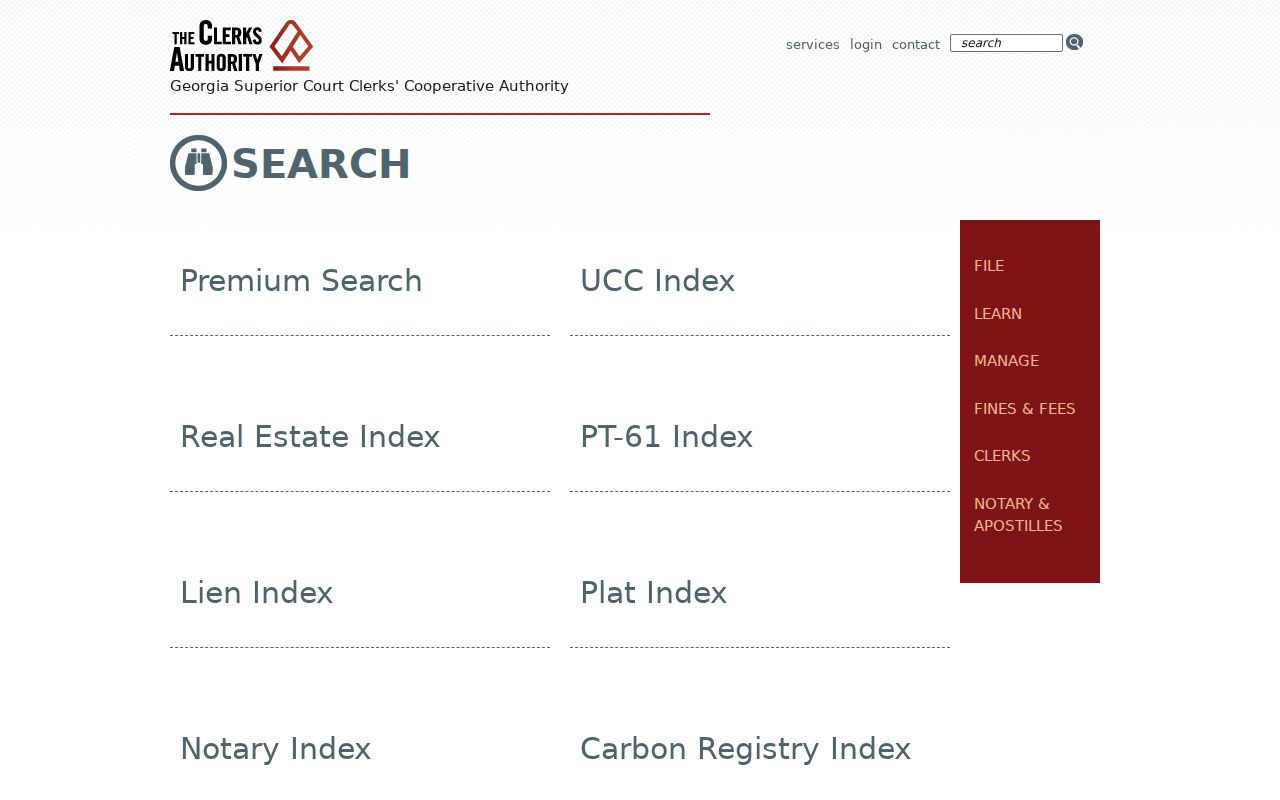
The official menu separates name and book-page searching from the volume browsing you need once Cook's online coverage ends.
The Cook County Historical Society and Genealogical Library, at 115 E. Fourth Street in Adel, holds family documents and photographs. Its listing shows Saturday hours of 9 a.m. to 2 p.m., so call first. Old Cook newspapers can link a former owner to an address, sale notice, estate, or vanished road name. Every clue still needs a deed match to count.
Test Old Cook County Place Names
Adel was Puddleville until its 1873 name change. Sparks, Cecil, and Lenox grew up as rail stops. Old newspapers, maps, and deeds may use a station, a route, a town, a land lot, or a former road name instead of a current street address. When the chain crosses that era, search both name forms.
Parcel numbers can change too, after a split, a merge, or re-parceling. Never force a current number onto every old record. Book and page, metes-and-bounds calls, subdivision lot and block, acreage, and adjoining owners can keep the chain intact across those shifts.
Note: An old address can point you toward a record, but the deed's legal description remains the stronger Cook County identity test.
Bridge Cook County Estate Transfers
An estate can break a clean chain of former owners. Executor's deeds and estate deeds each shift title in their own way. So do transfer-on-death deeds and life-estate clauses. The executor who signs the deed may never have held the land personally. That is why the Cook Probate Court file matters as much as the recorded conveyance. Pull the estate context there. Then return to the deed book for the land description itself.
Corrections, releases, cancellations, and plat amendments deserve their own notes too. They can explain a changed name or a changed description. Either way, they do not convey the parcel at all. The goal is a defensible chain, not the longest list of names.
Request Cook County Historic Records
Cook County's clerk does not publish a single universal form for deed copies. Ask the office which mail or certification route fits your request. Standard copies made onsite run $0.50 per page. A certified copy starts at $2.50 plus $0.50 for each added page. Online and nonstandard requests carry different fees.
A Georgia Open Records Act request works well for a plat, index, or other public record that never reached the web. Name the parcel and the legal description. Include the book and page, the parties, the date span, the record type, and the format you want. The county has no duty to build a chain-of-title report for you. Reconstructing that chain stays with the researcher.
Measure Cook County Ownership Depth
Former-owner research runs only as far as the surviving evidence allows. Cook's county books start with the county's creation in 1918. Anything older may sit with Berrien County or in state headright, bounty-land, grant, warrant, and plat collections. Note the endpoint and source of each branch rather than claiming a complete run of owners. For house history or purchase diligence, keep a researched list of previous owners distinct from a professional title search. Liens, probate rights, easements, and unrecorded claims can change the legal result.
Cook County's formation offers a firm geographic checkpoint. The county was cut from Berrien County in 1918. Any chain reaching land held before that year may continue in Berrien deed and tax books. Keep the later Cook legal description beside the earlier entry. Land-lot, district, metes-and-bounds, and plat language can carry the same tract across a county-name change. Street addresses did not yet exist in that era.
Older records spread across several channels. The Georgia Archives County Records Microfilm Index uses county cards to identify filmed holdings. Archives research help points to FamilySearch copies that may be browse-only. The Cook County Historical Society and digitized Cook newspapers can settle an old place name or family clue. Final proof still returns to the deed book, recorded plat, probate file, or another official instrument tied to the same land.
A historic address can shift while the parcel stays the same tract. Adel's older Puddleville name helps in newspapers and directories, but it is only a clue. Match it to a recorded owner, road, land lot, plat, or deed description before adding anyone to the chain. The 1939 courthouse and other landmarks can orient old maps. Yet they never replace the link between grantor and grantee.
Lawful use. Cook County ownership history supports house, estate, and land research. Do not use prior-owner names or addresses to track, threaten, or harass anyone.