
Deed Types Recorded in Cook County
Deeds in Cook County are filed and indexed by the Clerk of Superior Court. Each deed transfers an interest in land and carries a legal description. A security deed, lien, or UCC filing is different. Those can burden property without moving ownership. The clerk's current recording guidance names the instruments covered below.
| Deed Type | What It Does | Common Use |
|---|---|---|
| Warranty deed | Conveys title with stated warranties | Ordinary purchase |
| Quitclaim deed | Conveys the grantor's existing interest | Interest cleanup or family transfer |
| Executor or estate deed | Conveys through estate authority | Probate-related transfer |
| Foreclosure deed | Records a transfer after foreclosure | Power-of-sale process |
| Transfer-on-death deed | Names a beneficiary under state rules | Later death transfer |
The label is only a clue. Read the parties, the execution and recording dates, the legal description, any consideration, and prior book/page cross-references. A recorded name alone never explains every title right.
Cook Deeds Split Free and Paid Access
The clerk's real-estate records page sends searchers to free Cook qPublic first. Owner, address, parcel, sales, and plat references appear there. Recorded images work differently. Deed and plat images run through GSCCCA. They may need a paid subscription, though every local deed and plat record stays open for public research at the Adel office.
This split explains the free tax card puzzle. The card names the book page only. It stops short of the deed, so carry that citation to the clerk or run it through the statewide book/page mode. Call ahead about mail or email copies, since the clerk publishes no universal local deed-copy request form.
Note: Free reference access and paid image access are separate parts of the Cook County deed search.
GSCCCA Searches Cook Deed Records
The GSCCCA search menu offers name, book/page, property, instrument type, PT-61, lien, plat, and UCC routes. Cook's clerk suggests an owner-name search narrowed by date range and document type. Premium modes add instrument type, PT-61 address, and map sales data.
| Field or Mode | Form | Use |
|---|---|---|
| Owner, grantor, grantee | Name search | Find indexed parties |
| County | Selector | Limit results to Cook |
| Book/Page | Paired citation | Open a known record |
| Date range | Date filter | Narrow same-name results |
| Instrument type | Premium filter | Limit document class |
| Subdivision, block, lot | Property mode | Available for participating counties |
Cook participation in every property mode is not guaranteed, so confirm coverage as you go. The office counter remains the fallback for images, historical volumes, and certified copies. Staff can also confirm what each online mode returns.
Cook Deed Search Screen
The official statewide search page is shown in the project capture below.
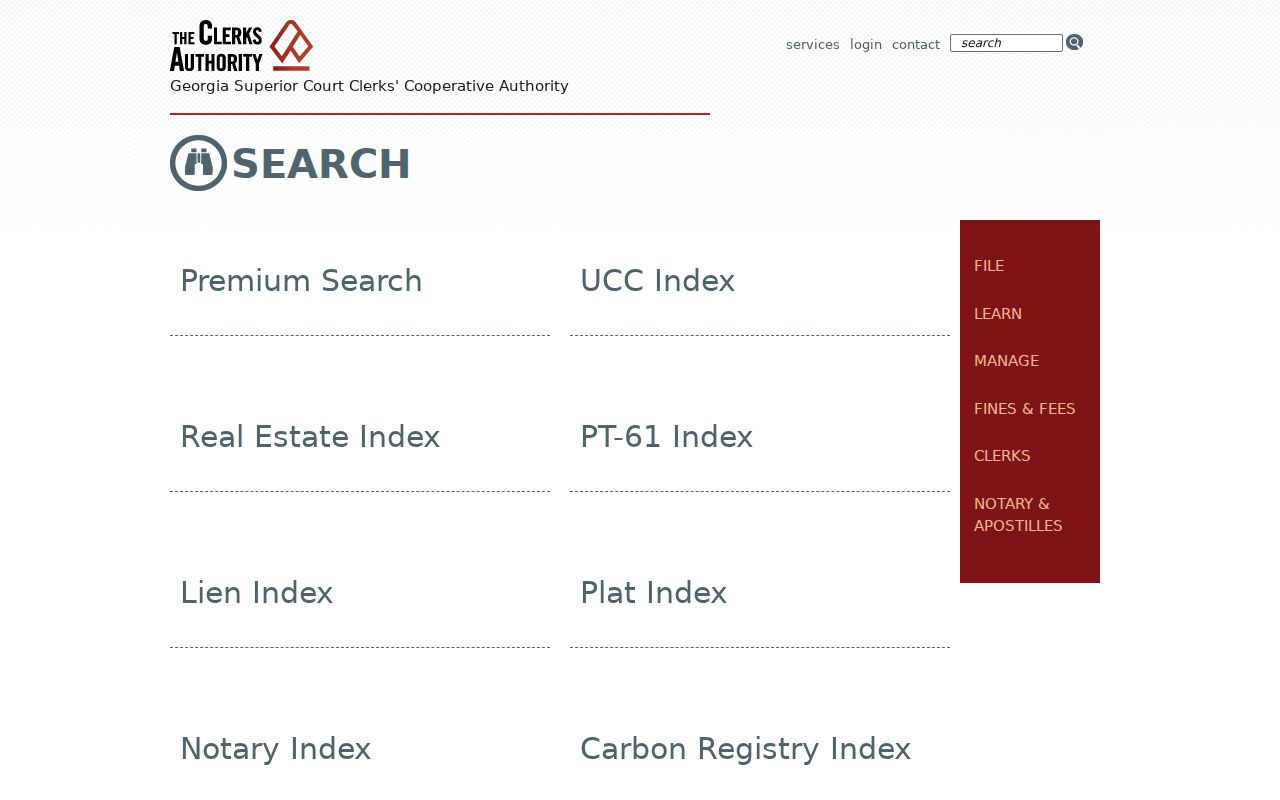
The search screen separates a known book and page lookup from broader name, property, lien, and plat searches.
Trace Cook's Grantor-Grantee Chain
A grantor gives an interest; a grantee receives it. Start with the current parcel card and its newest deed reference. Search the named owner as grantee near the sale date, then read the matched instrument's grantor and hunt that person as an earlier grantee. Each repetition builds a working chain of title.
- Copy the current qPublic Owner, Sales date, and book/page reference.
- Search that owner as grantee and confirm the legal description.
- Read the grantor, then search that party as an earlier grantee.
- Repeat while the parcel description remains continuous; switch to deed books when online results end.
- Grantor
- The party transferring the stated interest.
- Grantee
- The party receiving that interest.
- Chain of title
- The linked sequence of recorded transfers for one tract.
- Book/Page
- A volume-and-page citation used to retrieve a recorded instrument.
- Instrument number
- A separate unique recording identifier when assigned.
Legal Descriptions Control Cook Searches
A street address helps you find a parcel. The clerk demands more. Recording in Cook County requires a complete legal description, built from lot, block, and subdivision, a tract, land lot and district, or metes-and-bounds language. Match that description across each deed. Similar owner names or nearby addresses will mislead you.
qPublic shows a current plat reference only after a plat is recorded locally, while GSCCCA handles plat-name and plat book/page searches. Splits, merges, amended plats, vacations, easements, and rights-of-way can all bend the parcel trail. The tax map is no substitute.
Cook Liens Use Separate Dockets
Liens and encumbrances work differently from ownership deeds. Mechanics liens, judgments, tax liens, UCC fixture filings, easements, lis pendens, and security deeds each live in a separate docket. The right approach is searching the matching GSCCCA mode. That mode may be lien, real estate, UCC, or plat. When a lien gets canceled, released, satisfied, or assigned, the new instrument should cross-reference the earlier filing. That cross-reference is required in those cases.
Fees differ too. The clerk charges $25 to file a deed, an ordinary lien, or a financing statement. Each cancellation, release, satisfaction, or assignment carries the same $25 charge. Local and state tax liens follow a separate $5 filing fee. Specified reference and additional-page charges apply as well. Remember these are filing fees only. Copy prices are separate.
Cook Filing Rules Changed in 2025
Self-filers face new rules. Since January 1, 2025, they must use the GSCCCA eFile portal. They must also pass account and photo identity checks. Recording rules effective May 1, 2025 add their own requirements. Every document needs original signatures, a notary, and an unofficial witness. A return name and address is mandatory. So are the required top margin, a full legal description, and PT-61 where applicable. Plan on one to two business days for typical processing.
Copies and faxes never count as original filings. Clerk staff do not supply deed forms or legal advice. And a rejected filing never enters the recorded chain of title.
FANS Watches Future Cook Filings
The free Filing Activity Notification System watches for future recordings. Known as FANS, it sends alerts based on criteria each user sets. Coverage starts only after enrollment and applies to documents filed, indexed, and transmitted later. It cannot rebuild a past deed chain. Nor can it prove an older filing never existed.
An unexpected new record is still worth flagging, though. Confirm any alert with the clerk or GSCCCA before acting. Georgia consumer guidance describes an identity-validation process effective January 1, 2025 for title-deed and related property filings. The process reinforces checking suspicious activity through official channels.
Cook Land Chains May Enter Berrien
Cook County split from Berrien County in 1918. That date matters for deed research. A land chain begun before the split may still sit in Berrien's deed books or old tax rolls, so a modern road address alone will not carry the trail back. Work from the land lot, district, and full legal description, then trace the predecessor county and any later Cook citations. The Georgia Archives County Records Microfilm Index catalogs county record titles with their date spans and is the best first stop for framing a search window. It does not state Cook's earliest online deed year or the imaging cutover. For older parcels, the clerk, the Archives cards, the FamilySearch catalog, and local historical collections each hold pieces. No courthouse record loss is reported for Cook.
Cook Filing Alerts Onscreen
The official FANS enrollment page is preserved in this project capture.
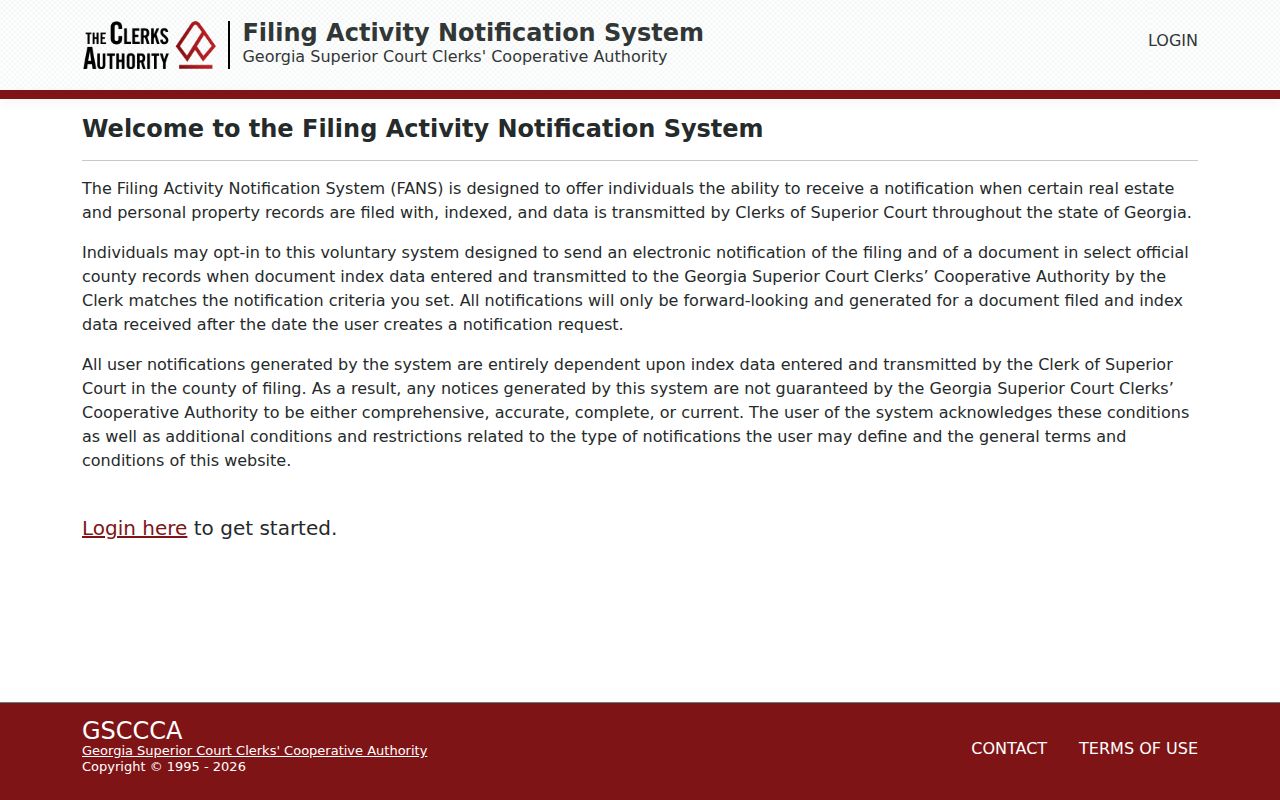
The page points to the state's official alert service. The clerk of court remains the authority for matching any notice against the recorded instrument itself.
Order a Cook County Deed Copy
Ordering a Cook County deed copy goes faster with the right details in hand. Pull the parties, document type, recording date, and book and page first. At the local office, standard copies run $0.50 per page. A certified copy costs $2.50 for the first page plus $0.50 for each additional page. Nonstandard, unscanned, odd-size, or hands-on copies run $1 per page.
Online pricing differs from the counter. The eCertification route lists $2.50 for the first certified page. It adds $0.50 for each added page. The standard electronic copy page lists $2.50 for the first page. Each additional one costs $1. Card processing fees apply on top. Confirm which transaction you are making before paying.
In person, the Clerk of Superior Court sits at 212 N. Hutchinson Avenue in Adel, open Monday through Friday from 8 a.m. to 5 p.m. Call (229) 896-7717 before traveling or mailing a request. Ask whether your citation is scanned. Also ask what identification, payment, return envelope, or certification instructions the office needs.
Recorded, not guaranteed. Cook County deed records show instruments accepted for recording. They are not a title opinion, and unrecorded or misindexed interests can exist.