
Cook County Owner Record Card
Cook qPublic labels the tax-roll party as the Owner. That label comes straight from the tax roll. The card is an assessment record, not a deed. Even so, it carries the clues needed to test an identity against the land and the latest transfer. One view gathers the owner label, parcel, site, mail destination, sales data, and recorded references.
| Owner | The current tax-roll name, including an entity or public body |
|---|---|
| Mailing Address | Where assessment mail goes, which may differ from the site |
| Physical Address | The parcel's situs, sometimes only a rural road label |
| Parcel ID | The exact map and tax key used to separate similar matches |
| Last Sales | Date, price, reason, and qualification clues |
| Deed or Plat Reference | The book/page bridge when one is shown |
An owner of record is not the same as an occupant. Cook qPublic separates Mailing Address from Physical Address for that reason. A PO box, trustee address, or company office can be perfectly valid mail data. It does not prove anyone lives there. Parcel ID and deed reference are safer keys.
Time the Cook County Owner Check
No official Cook source states how often the owner roll refreshes. None gives a day count between closing and update. Any fixed promise would be invented. Instead, read the live card's sales and upload data, then check the latest instrument in the deed index whenever a transfer is recent.
One official qPublic sample carried a 2021 upload timestamp. That proves a card can display freshness information. It is not a countywide schedule. The newest indexed deed can still be more current than the assessment owner label.
Fresh transfer. A Cook County owner record can lag a sale. Confirm the current owner with the latest deed and ask whether it has finished indexing.
Confirm the Cook County Current Owner
Start with the free Cook qPublic search to identify the parcel. Then move to the recorded instrument itself. Cook's clerk points users to qPublic for references and to GSCCCA or the courthouse for deed records and images.
- Search the address or parcel and copy the Owner name exactly as displayed.
- Note the sale and deed-book reference, then search the name as grantee in the GSCCCA index.
- Match recording date, instrument, book/page, and legal description to the same parcel.
- For a company, trust, or estate, preserve that legal name and consult the matching record.
- Owner of record
- The party named on the current public roll.
- Assessment roll
- The county record used to value and identify tax parcels.
- Situs
- The land's physical location, distinct from the tax mailing address.
- Recording lag
- The time between a transfer and its appearance in another public system.
Compare Cook County Sale Fields
The qPublic Last Sales area can show a date, price, reason, and qualification. Those entries are clues, not conclusions. A family transfer, estate conveyance, corrective deed, or deal without a usable price may not read like an ordinary sale. The book reference under Sales often beats the price. It points to the filed instrument.
Take the search to GSCCCA next. Use the same name, date range, and document type. If an online image requires payment, all Cook deed and plat records remain open at the Clerk of Superior Court. That office sits at 212 N. Hutchinson Avenue in Adel, open weekdays from 8 a.m. to 5 p.m. Call (229) 896-7717 before traveling.
Resolve Cook County Entity Owners
The current owner may surface as an LLC, corporation, trustee, or estate. Search that exact label. Georgia's ecorp business search accepts several fields. You can query by business name or control number. It also takes registered agent, officer, and designated-agent fields. A hit can explain a remote mailing address.
The official Georgia business search screen supplies the entity fields for this second check.
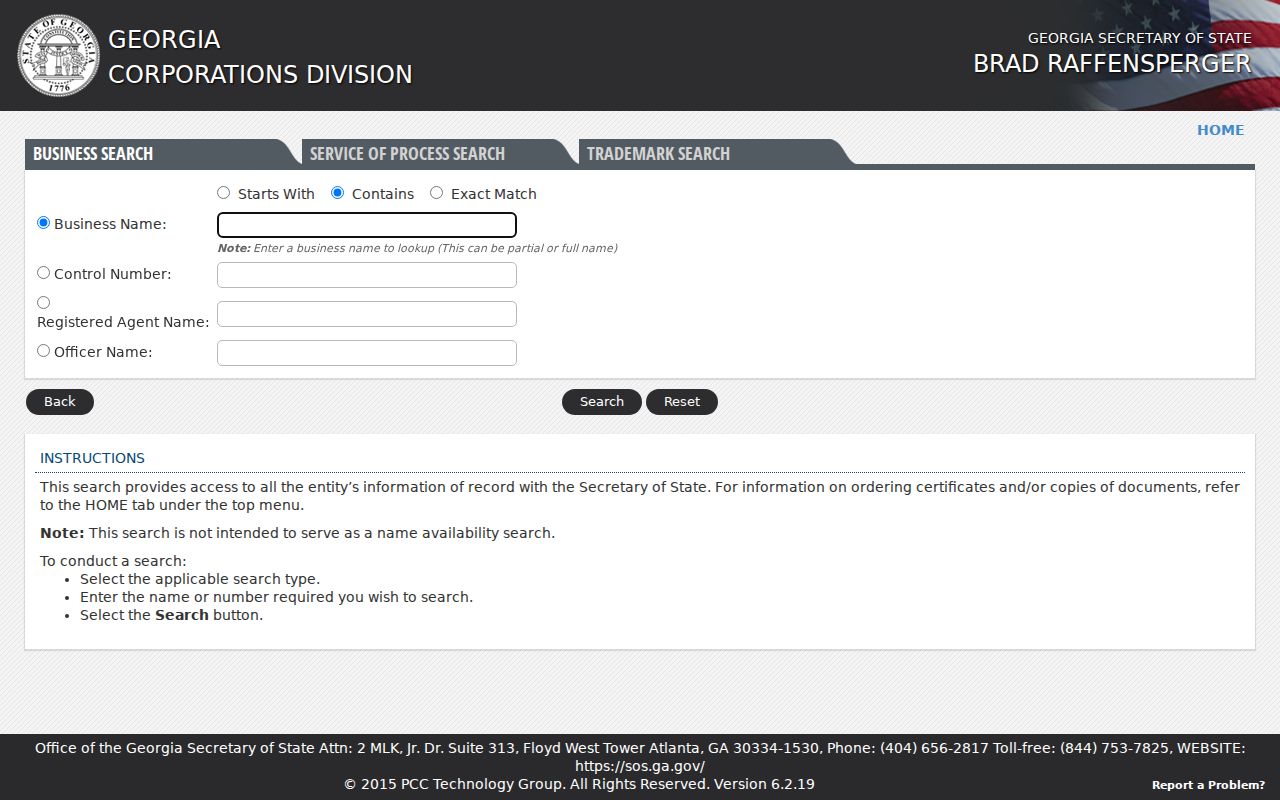
An exact legal business name works better as a search key. A guessed individual name does not. The registered agent may not own the land. An executor can manage an estate without holding it personally. The deed language and Probate Court file add context. Use the parcel's legal description to tell similar entity names apart.
Match Cook County Parcel References
Cook parcel identifiers can contain spaces and letters, like the sample form 0040H 029B. The county publishes no decoding grammar, so copy the ID exactly as shown. It may change after a split, merge, or re-parceling. The latest deed's legal description and the recorded plat remain the key checks.
The assessor map adds roads, aerial context, outlines, and labels. It helps select the right tract. Its warning bars use in legal documents. Boundary disputes call for a plat and survey.
Note: Physical and mailing addresses can differ without creating an ownership conflict. The parcel and recorded description control the match.
Reach Cook County Owner Offices
If qPublic is down or confusing, call or visit the Board of Tax Assessors at 209 N. Parrish Avenue in Adel. You can also dial (229) 896-3665. Have the physical address, parcel ID, and owner label ready. The clerk can tell you whether a recent instrument has recorded. The clerk can also walk you through image or certification options. The local pages publish no universal deed-request form. So ask the office for its current mail procedure.
A record may not be online. For that, a focused Georgia Open Records Act request works well. State the address, parcel, date range, record type, and the format you want. Agencies generally must produce the records. Or they must respond with a status, time, cost, and any exemption within three business days. They are not required to create a new owner report for you.
Monitor Cook County Owner Filings
The Filing Activity Notification System watches for documents filed after you sign up. It is a watch tool, not a history search. Silence does not mean an older deed is absent. Treat each alert as a lead. Check it against the official index.
Self-filed real-estate documents have used identity-verified GSCCCA e-filing since January 2025, according to Cook's clerk. Updated rules took effect in May 2025. A suspect filing should be pulled by its book/page. Compare it to the genuine instrument. Report it to the clerk and law enforcement.
Contact a Cook County Owner Lawfully
The assessment mailing address is the lawful public channel for a good-faith property question. It may reach an owner, a trustee, or a company office. The addressee does not necessarily live at the parcel. Never try to defeat protected-address programs or sealed records. Remember that VoteSafe can shield eligible voter residence addresses.
A current owner lookup is not proof of occupancy. It is also not a title search, a survey, or legal advice. For a purchase, estate, easement, or title dispute, work from the recorded deed. Get professional help suited to the issue.
The public record preserves distinctions a name-only result can hide. A deed may vest title in more than one grantee. It may reserve an interest. It may also name a trustee in a representative role. The qPublic Owner field may shorten that detail for the tax roll. When the exact form of ownership matters, review the vesting clause and the legal description. If a probate transfer is involved, the Cook County Probate Court file can explain who held authority. The later recorded instrument shows what actually reached the real-estate records.
State freshness with care. Cook County publishes no fixed roll-refresh interval. So a current-owner claim should name both the source and the date checked. Save the parcel ID and note any card upload date. Compare the newest Sales row to the newest indexed deed. If those fields conflict, the Clerk of Superior Court can confirm whether an instrument is recorded and indexed. That check beats assuming both screens update at once.
Note: Quote the recorded grantee and vesting terms exactly. Save the recording date and book/page to keep the Cook County parcel match clear.
Lawful use. Contacting a Cook County owner about a real property matter is legitimate. Using public owner data to stalk, threaten, or harass anyone is prohibited.