
Compare Cook County Property Values
Three figures drive value research in Cook County. Fair market value is the assessor's opinion of value. It estimates what a parcel would bring in an open sale on the assessment date. Assessed value applies the statutory fraction Georgia uses for taxation. The last sale price is simply history. It records one past transfer. Its terms may look nothing like a current open-market deal.
| Value type | Meaning in Cook County | Record source |
|---|---|---|
| Fair market value | County appraisal estimate as of the annual valuation date | Board of Tax Assessors record and annual notice |
| Assessed value | Ordinarily 40 percent of fair market value under Georgia's system | qPublic card and assessment notice |
| Last sale price | Price shown for a prior transfer, subject to reason and qualification | qPublic Last Sales, deed, or PT-61 record |
Assessed value never copies the sale price. Georgia generally sets it at 40 percent of fair market value. Exemptions then trim the taxable amount while leaving the market estimate untouched. In Cook County, the Board of Tax Assessors keeps the appraisal record. The Tax Commissioner handles billing and collection rules.
Read Cook County Assessed Value
A Cook qPublic parcel card carries the Parcel ID, class code, taxing district, acreage, owner of record, mailing and physical addresses, assessed value, and last two sales. It also lists a plat reference. Those fields tie a value to the right tract. They show whether a sale is comparable too. One sample card listed a $31,980 assessed value on 5.33 acres. That single record says nothing about the parcel next door.
The same card carried a 2021 upload stamp. Dates belong to the card, not to a countywide cycle. Cook County publishes no fixed roll-refresh interval. Confirm the year and the live figures before using a number in a current decision.
The county's property-tax explanation covers the local assessment framework behind these values.
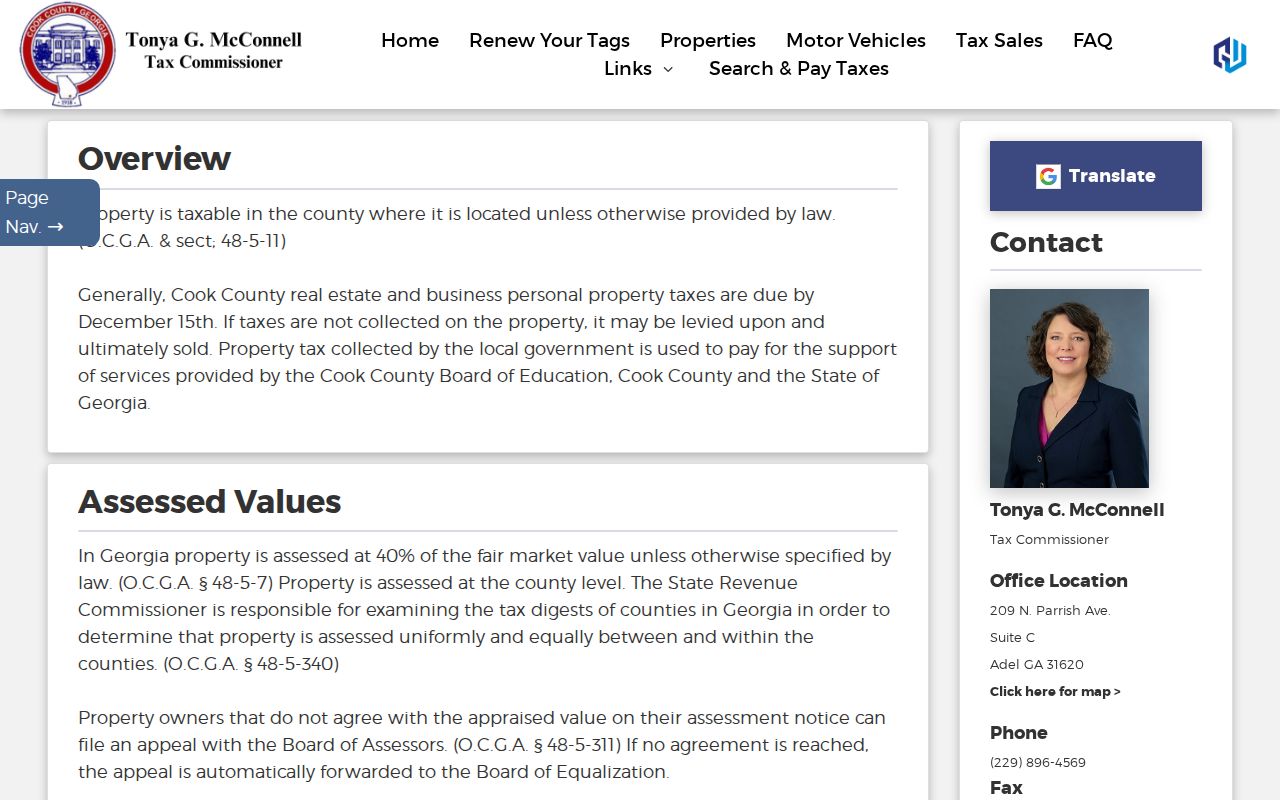
The county page keeps assessment rules separate from payment questions. That separation gives the public one official spot for current local guidance on Cook County values.
Locate a Cook County Property Value
Begin with the assessor. The parcel card links each value to a physical site and an owner label. Copy the parcel ID exactly as shown, every letter and space. Cook County publishes no decoder for identifiers like 0040H 029B. A guessed format risks pulling the wrong record.
- Search the address, owner, or parcel in the Cook qPublic portal.
- Confirm the physical address, parcel ID, taxing district, acreage, value, and record year.
- Read the Last Sales date, price, reason, and qualification rather than copying price alone.
- Use the deed or GSCCCA PT-61 data to understand the transfer behind a sale figure.
- Assessed value
- The value produced by applying the statutory assessment level.
- Fair market value
- The county's full-value estimate for assessment.
- Assessment ratio
- The share of fair market value placed on the tax roll, ordinarily 40 percent in Georgia.
- Consideration price
- The amount tied to a transfer, which may appear in deed or PT-61 data.
- Reassessment
- A new review of value for a later tax year.
Date Cook County Value Records
Georgia reviews property every year. Fair market value is pegged to January 1. That annual rhythm is not the same thing as a countywide revaluation cycle. A later assessment can shift for many reasons. New permits, building changes, land splits, recent sales, and uniformity work all play a part. Cook County's assessor also posts standing notice. Staff inspect property, including permit sites and mobile homes.
Always read a value with its year attached. A sale after January 1 can inform future appraisal work. It does not automatically rewrite the existing record. Market conditions may also move between the assessment date and a later purchase decision. That is why the year matters as much as the number.
Test Cook County Sale Prices
qPublic's Last 2 Sales area includes reason and qualification fields. A price becomes a market clue only after those fields and the deed are clear. Family transfers and estate deeds may fail the arm's-length test. Foreclosures, quitclaims, partial interests, and corrective instruments may fail it too.
GSCCAA runs sales-price and PT-61 searches, plus grantor, grantee, book/page, property, and instrument modes. Some access is premium. Numbers can conflict. Check the recording date. Match the legal description too. Only then decide whether both sources describe the same transfer.
Separate Cook County Taxable Value
Homestead and other exemptions can shrink taxable value. They leave the county's fair market estimate untouched. Cook requires homestead applications at the assessor by April 1 for that year's benefit. That deadline governs exemption administration, not market price.
The Tax Commissioner bills, collects, and distributes taxes. The assessor maintains the digest. For tax amounts, exemptions, and appeals, turn to the site's Cook County property tax records material.
Note: A lower taxable figure can mean an exemption applied, not a drop in the county's market estimate.
Keep Cook County Maps in Context
The qPublic map draws parcel outlines, roads, aerial imagery, labels, and selected-card details. It confirms a value belongs to the right tract. The map carries a warning, though. It is not for legal documents, and an incorrect line, stale split, or incomplete address can distort any comparison.
Boundaries come from the recorded plat and survey. A larger outline proves nothing. A visible building or a nearby sale does not either. Land use, improvements, condition, rights, and sale terms all demand reliable records.
Ask Cook County About Values
For valuation questions in Cook County, start with the Board of Tax Assessors. The office sits at 209 N. Parrish Avenue in Adel, and the phone number is (229) 896-3665. Staff there handle the property card, the valuation record, and assessment questions. If the online portal is down, call or visit. Bring an address and parcel ID handy.
Records missing from the portal can still be requested. The Georgia Open Records Act covers existing files. Ask for the parcel, year, and fields you want. Include the date range and your preferred format. The agency normally must produce the records or reply with status, timing, cost, and any exemption response within three business days. It does not have to create a private appraisal or a new valuation analysis.
Limit Cook County Property Value Claims
The Cook County tax figure exists for assessment. It is not a sale price, an offer, a replacement-cost estimate, a survey, or a private appraisal. The most recent recorded sale may be old or unqualified too. Where current market value matters, such as a purchase, an estate, or a dispute, get work from a qualified appraiser. Hand that professional the correct parcel and the relevant records.
A value is only as good as its label. Note whether a number is a tax figure for a stated year. It may instead be a county fair market estimate, or a recorded sale price on a stated date. That habit keeps three distinct Cook County records from collapsing into one vague figure.
Timing can split the numbers even when every source is right. Assessment work rests on a January 1 valuation date. The Last Sales row may reflect a transfer from another month or year entirely. A renovation, a land split, a new exemption, or a non-market deed can widen the gap further. Record the date beside every Cook County property value. Compare like periods before calling something a trend.
The official sample card shows why source notes matter. It lists an upload timestamp, acreage, an assessed figure, and a past sale row. That single example proves no countywide refresh schedule. It also proves no current value for any other tract. For a specific parcel, check the live qPublic card, the annual notice, and the recorded sale source. Keep the parcel ID with every saved value.
Value is not price. Cook County assessed value serves the tax system. It does not establish what the property would sell for and is not an appraisal.